A lifelong prolific writer suddenly can’t string together a sentence. Each time she tries, her chest becomes heavy with the weight of the ideas she wants to capture and convey, but can’t. Then the fire starts in her lungs, scorching her from the inside as she searches and searches for words that become harder to find in the metaphorical smoke from the asthma burning up her insides.

At night, in bed, unable to sleep, the words and sentences bubble up, straining against an unpopped cork about to shatter the bottle neck now under extreme pressure. But the heavy heart and lung fire come too.
As she gets up to capture the words, the pain intensifies, impairing her capacity to remember what she wanted to write. As soon as she stops desperately searching for those uncommitted sentences, the physical pain subsides.
Healing with Art
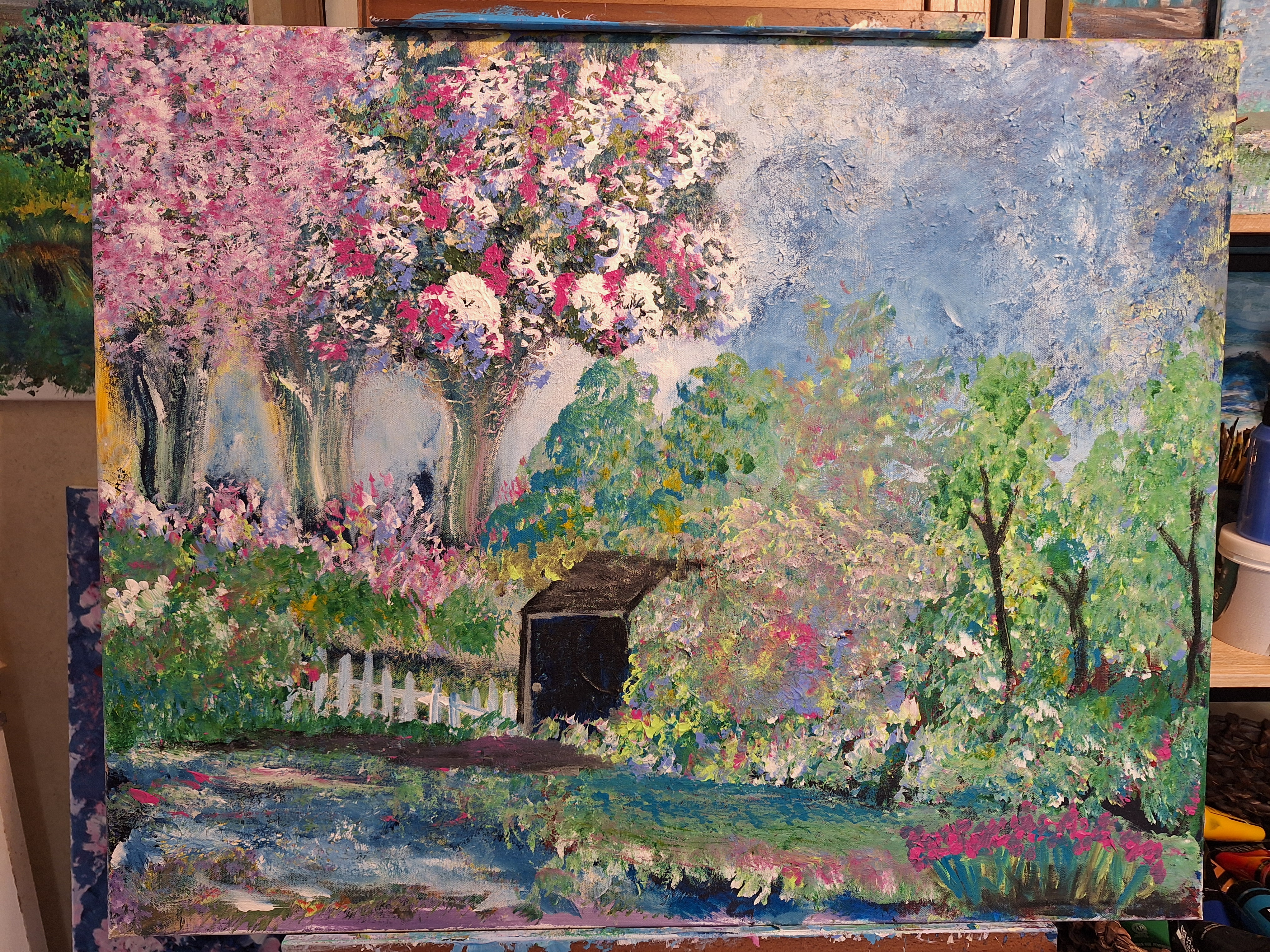
Wordless and alone with a blank mind and a blank canvas, she reaches for brushes and the cheap acrylic craft paints she has on hand. She creates shapes and tries to color over her lost identity because she doesn’t know who she is if she can’t write.

There is a gaping schism in her life and she feels the widening distance between the writer she used to be and the no one she is becoming.
Here, she expresses in paint that which she can no longer record in her journal. Even penning her personal reflection on those private pages, her long time mechanism for finding herself and her way in the world, has been lost to her. She is nothing without her capacity to craft words and the emptiness of night is the only time she doesn’t feel like a fraud.

Here alone, she can be nothing. She can feel at ease with her loss of identity. She doesn’t have to maintain some artificial, imaginary thread between who she used to be in the world and the wordless soul adrift she has become.
Here in the night, she entertains herself with pretty colors on paper because she has has allowed herself to be reborn as woman-child, learning a new medium, to survive without sentences.

Here she creates secret paths and doorways on canvases that lead to places words can’t go. She reflects on trips taken, experiences had, and tries to remake herself in a new image.

Lately, words have returned, less free-flowing than before. Yet, more meaningful sentences take shape and important ideas become less illusive in the intense struggle to write.
Writer with a Word Problem
Mine was not a true aphasia. It was an emotional aphasia — mystically transferred to me in the days leading up to the death of the true aphasia bearer.

My dad, Mike Greer, suffered a massive, nearly terminal brain bleed that wiped out his capacity to create new memories for the last 8 years of his life.
Like an abstract painter, he could capture only elusive strokes of what came before. Yet the images were sometimes more meaningful and beautiful in their incompleteness. Along with that memory loss, came inability to use and comprehend language – spoken, heard, written, read.
In a final departing gift, his global aphasia seemingly splintered and pierced my heart, paralyzing my power to pen sentences without pain. After his death — as I struggled to learn wordless ways of expression through the medium of pain and paint — it became obvious to me that my dad had a similar experience after his stroke.
He had not learned to communicate in paint when his words failed because even pictorial representations read like a foreign language to him. He did it with love, impeccable comedic timing, and overtly obvious graciousness that made his attention givers feel deeply appreciated.

The Subconscious
After his passing, many people, trying to offer solace, told me my dad had gone on to a better place. That idea – so completely incongruous with who my dad was in life and what he believed — made me physically repulsed and eager to flee. Yet, instead, I channeled his post-stroke, overtly gracious persona and tried to receive the intent behind the words, even as the actual words abraded my inner ear skin like sandpaper. I am grateful for the example of his wordless years because it saved me from alienating good people I care about over words that were meant with love.

My dad did not believe in heaven and hell, except the ones we make for ourselves while incarnated in human form. He thought most humans were exceptionally good at taking the short, bright, easy paths that lead only to a constant need to dull their disappointment and boredom with the hope of some great hereafter, drugs, distraction, or all three.

He held no malice for people who chose to live what he called those kind of surface lives. But he taught me to believe only in things you couldn’t see from the trailhead. He urged me to search for signs from my subconscious and clues in my dreams, to listen to my deeper self, and whenever possible to choose the riskier, less obvious, and possibly failure-strewn paths precisely because they made better fodder for writing stories worth telling and led to more moments of profound meaning to reflect back on.

My dad also believed we would all spend time in a transition space before our next incarnation — a kind of reflective purgatory where we would reconcile with our past to prepare for our next return. He believed his purgatory (this time) would be lengthy because he had to reckon with the sins of his psychosis that started with a schizophrenic break at age 18.
While institutionalized, he was diagnosed with multiple personality disorder and delusions of grandeur. Once released, he began a life long battle between his brain-driven urges and his heart’s desire to be civilized. He spent most of his time on earth in philosophical pursuit to avoid succumbing to the side of his Janus-self he could not tolerate.

He worked as an overnight security guard so he could read books and take walks for a living. He loved philosophical discourse so much that he once he spent 11 cassette tape hours, sharing his knowledge on Socrates with me so I could use him as a source for my term paper.
For a person with that much to say on a single subject, eight years without memory or language seemed like a diabolically perfect purgatory. And as his caretaker/witness bearer during those post-stroke years, it also became a perfect purgatory for me to work out my sins as well. (Mine stem not from psychosis, but from lack of self-esteem and a deeply held belief that I must continually prove myself worthy of love to receive it.)

As our shared purgatory drew to an end, for three days leading up to his death on April 25, 2024, my dad’s language skills were miraculously resurrected. Like Lazarus, his language came back from the dead, smothered and suffocated dark side of his brain and he became able to string together complete sentences for the first time since March 2016.
Some of the last words he spoke to me were “I’m going to die soon. It’s not good. It’s not bad. It’s normal. It’s fine. It will be okay.”
To which I responded, “I know.”

That memory becomes infused with different kinds of meaning and new nuanced details upon each new examination. Yet the constant, in each reframed iteration, is the acute pain in my heart and inability to say more than “I know” as the certainty of his impending death settled over me.

Perhaps that was the very moment when a sliver of his aphasia pierced my heart and stayed my pen. Perhaps on a subconscious level, I knowingly exchanged my writing skills to hear him speak those final words of comfort. Certainly, some deep part of me would sacrificed anything to know what he thought as he peered over the ledge on the precipice of death.
Or perhaps, this is just my way of turning a moment of meaning met into fodder for a story worth telling.


As the 1st anniversary of my dad’s after this life approaches, and of my life after dad’s death, those countless sleepless nights and color-filled canvasses have begun to heal the schism inside me. And his old bedroom has become my art studio turned dining room.


After his stroke, I divided my dad into two different people because I couldn’t reconcile the old child he’d become and with the wise father who taught me to live a philosophically seeking life. I put the wise father version of him on hold, as if he was still there just out of the picture somehow. I suppressed memories of him because when I thought of him, it made me angry at the child in his body and sad over all the conversations I could no longer have with him.
By seperating the “wise father” part of him, it allowed me to embrace the “child dad” as a different person and care for him as a mother would, with unconditional love. In retrospect, that choice may have been the shallow path my dad warned me to avoid. Yet I do not know how I could have survived those eight years in purgatory with my dad any other way.
For his whole adult life, my dad carried within him bifurcated versions of his personality. Like the story of the two wolves inside us all, he worked hard to feed the one he considered his better self.
As his daughter, I knew the nature of his two selves. I was able to love him wholly knowing all that he was and all that he tried not to be. And so it smacks of strange irony that I had to mentally separate my before-stroke-dad from my post-stroke-dad to be daughter to one and caretaker to the other.
Over this year since his passing, sharing his aphasia (however it came it be), I have begun to reconcile that inconsistency within myself. I can now see the continuous thread of his humanity in the two warring versions of himself and the pre and post stroke versions I created as an act of self-preservation.
In the prism person he was, and I made him out to be, there was also something constant and uniquely him. And I like to believe that that continuity, went on to something new here on earth after he left his body.
It’s not good. It’s not bad. It’s normal. It’s fine. It will be okay.
I like to believe that as my dad peered over the precipice, and spoke those last words of wisdom, he became one whole and made his peace with his internal struggle.

I like to believe that I will too. I am searching for signs from my subconscious and my dreams, listening to my deeper self, and looking for the riskier path that will make for better fodder for my story and allow more moments of meaning to reflect back on. And I am trying to love the part of me that has nothing to prove to earn it.

You only have one life, until the next, as my dad used to say.

Leave a Reply