“What does the river say to you?” Our lead raft guide asked us this question as we drifted down the Green River through Labyrinth Canyon.
Though we’d been in constant communication with the river for days, neither Matt nor I could answer. We each gave round about explanations on taking it all in and processing later.
Our guide said another rafter summed up similar sentiments in a metaphor that I (as a poultry keeper) found particularly helpful: We were taking home a lot of good eggs to incubate.
The egg idea had truth. And I’ve certainly been setting many good eggs, collected on the trip, since we got back. But it wasn’t my reason for declining to answer.
Earlier that day, our trip interpreter (acclaimed author Craig Childs and regional expert) shared this perspective:
A labyrinth, like the one we were winding our way through, is something you flow with and follow to its natural end. A maze is something you get lost in and have to find your way out of by effort (or not).
The 45 mile river stretch we flowed down had one starting point and one ending point. Yet there were countless ways to make our own mazes by wandering too far from its muddy waters, into the massive canyons, crevices, and open desert (or the messy mental mazes we make in our own minds).
At that moment, I needed to remain in the labyrinth and under the influence of that incredible, wild, and sublime landscape.
To apply human language to the river’s message would require effort. And that would effectively portal me right back into the human world mazes I left at home.
Also, attempting to confine the river’s message in words felt analogous to damming the river itself — a temporary and reductive effort, to be regretted later, even if those words did hold water for awhile. And after learning about the Green River, Lake Powell, and Glen Canyon, during a pre-trip visit to the John Wesley Powell River History Museum, I felt bound not to put my words in the river’s mouth or limit the places it’s message might flow from there.
Now through a retrospective lens, I can confirm the Green River speaks volumes. It’s powerful story telling is why Matt and I were drawn there. It created the confluence of our group of wonderful travel companions, from all walks of life and far away places, whose reverence and respect for the river and surrounding environs inspired me deeply.
The engaging, often profound, conversations we had with the landscape and our human companions in the wild dark and all along the river feel life-altering.
Yet it also flowed too fluently to capture in concept. Instead, I tried to become a fluvial flood plain, collecting unsifted silt to sow seeds and sprout new understandings in later.
Now with some distance, I recognize I wasn’t just a repository. At a rate of 2200 cfm per second — the Green River did to me what it did the landscape all around. It carved new canyons, created rifts and crevices in some places, even as it spilled sediment and started sandbars in other areas. It has reshaped my entire psyche in ways I feel, but can’t verbalize.
Unlike my suitcase (which is emptied and stowed away until the next adventure), it will take much more effort to unpack my experience in the labyrinth. Yet, even in this early stage initial processing I’ve been led into a new maze of questions and possibilities for the central human question — How should we live?
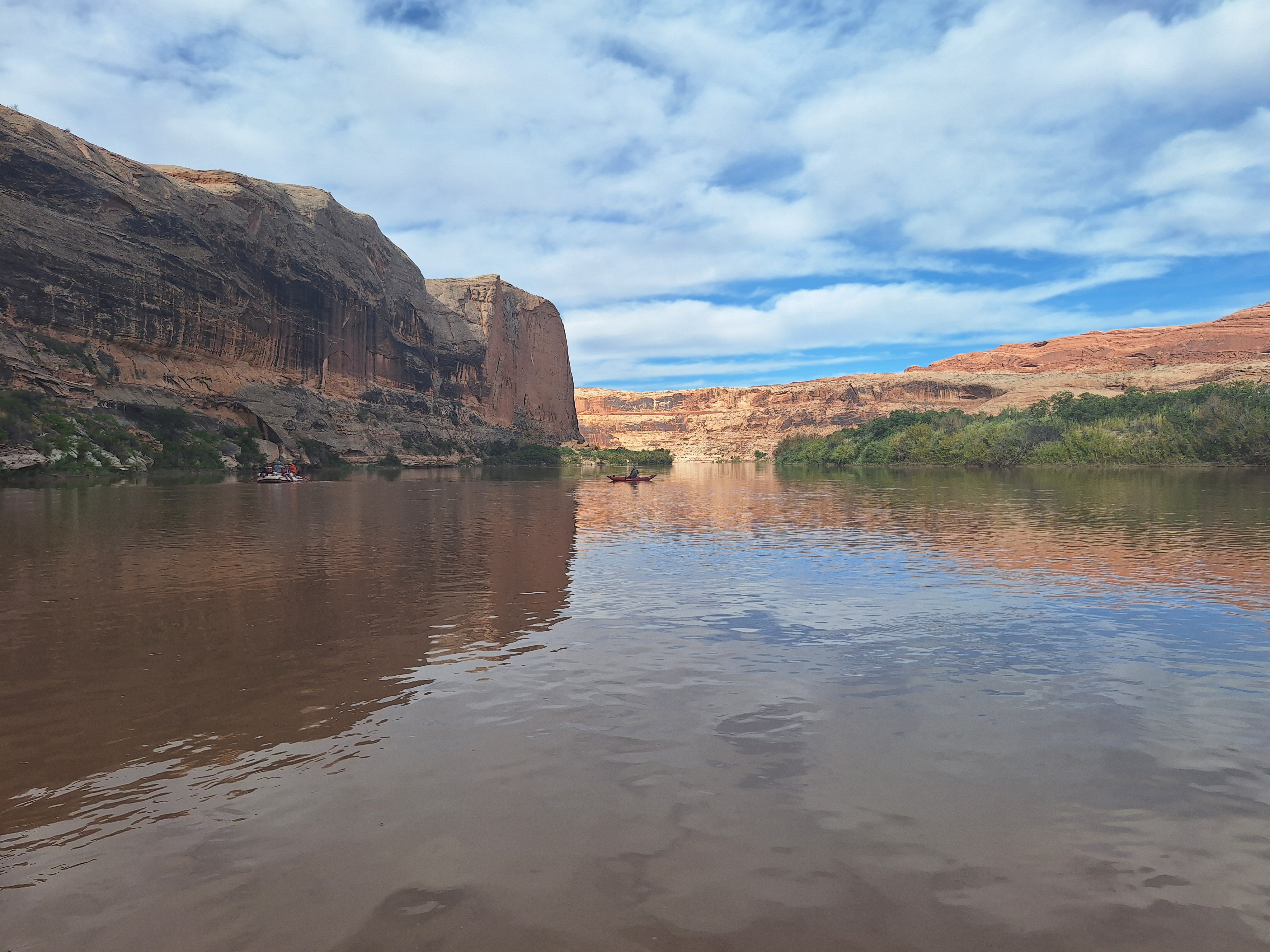
On a final note, I took the photo above when I was silently contemplating the question “Is the river alive?” (after someone mentioned Robert MacFarlane’s book with the same name).
We rounded a canyon curve and the unique rock formation above drew my attention like a magnet. I suddenly had no doubt about the correct answer to that question.
River flow, so slow Sublime loss of time, divine Want to stay this way


Leave a Reply