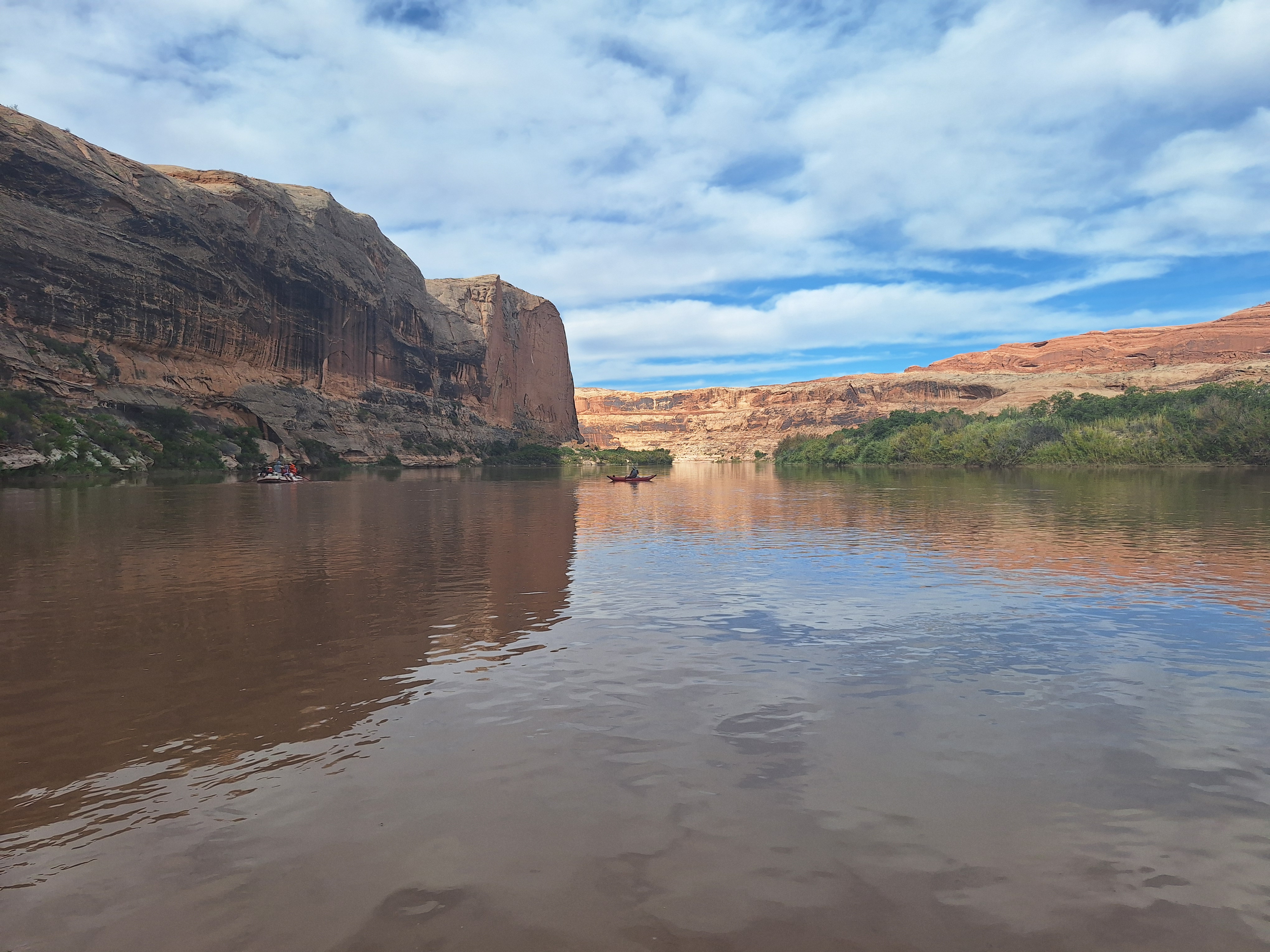
“What does the river say to you?” Our lead raft guide asked us this question as we drifted down the Green River through Labyrinth Canyon.
Though we’d been in constant communication with the river for days, neither Matt nor I could answer. We each gave round about explanations on taking it all in and processing later.
Our guide said another rafter summed up similar sentiments in a metaphor that I (as a poultry keeper) found particularly helpful: We were taking home a lot of good eggs to incubate.
The egg idea had truth. And I’ve certainly been setting many good eggs, collected on the trip, since we got back. But it wasn’t my reason for declining to answer.
Earlier that day, our trip interpreter (acclaimed author Craig Childs and regional expert) shared this perspective:
A labyrinth, like the one we were winding our way through, is something you flow with and follow to its natural end. A maze is something you get lost in and have to find your way out of by effort (or not).
The 45 mile river stretch we flowed down had one starting point and one ending point. Yet there were countless ways to make our own mazes by wandering too far from its muddy waters, into the massive canyons, crevices, and open desert (or the messy mental mazes we make in our own minds).
At that moment, I needed to remain in the labyrinth and under the influence of that incredible, wild, and sublime landscape.
To apply human language to the river’s message would require effort. And that would effectively portal me right back into the human world mazes I left at home.
Also, attempting to confine the river’s message in words felt analogous to damming the river itself — a temporary and reductive effort, to be regretted later, even if those words did hold water for awhile. And after learning about the Green River, Lake Powell, and Glen Canyon, during a pre-trip visit to the John Wesley Powell River History Museum, I felt bound not to put my words in the river’s mouth or limit the places it’s message might flow from there.
Now through a retrospective lens, I can confirm the Green River speaks volumes. It’s powerful story telling is why Matt and I were drawn there. It created the confluence of our group of wonderful travel companions, from all walks of life and far away places, whose reverence and respect for the river and surrounding environs inspired me deeply.
The engaging, often profound, conversations we had with the landscape and our human companions in the wild dark and all along the river feel life-altering.
Yet it also flowed too fluently to capture in concept. Instead, I tried to become a fluvial flood plain, collecting unsifted silt to sow seeds and sprout new understandings in later.
Now with some distance, I recognize I wasn’t just a repository. At a rate of 2200 cfm per second — the Green River did to me what it did the landscape all around. It carved new canyons, created rifts and crevices in some places, even as it spilled sediment and started sandbars in other areas. It has reshaped my entire psyche in ways I feel, but can’t verbalize.
Unlike my suitcase (which is emptied and stowed away until the next adventure), it will take much more effort to unpack my experience in the labyrinth. Yet, even in this early stage initial processing I’ve been led into a new maze of questions and possibilities for the central human question — How should we live?
On a final note, I took the photo above when I was silently contemplating the question “Is the river alive?” (after someone mentioned Robert MacFarlane’s book with the same name).
We rounded a canyon curve and the unique rock formation above drew my attention like a magnet. I suddenly had no doubt about the correct answer to that question.
River flow, so slow Sublime loss of time, divine Want to stay this way
The new kitchen garden is slowly taking shape and starting to deliver on daily fresh ingredients.
The first four raised beds went in two months ago, just before the coop and run were delivered. I planned to immediately add four more after the install. But watering, in our current dry conditions, consumed most of my available gardening time.
Bone dry soil also made made fruit tree planting more time consuming. I had to resort to triage mulching (covering just enough area to keep feeder roots from dehydration). But all fruits are now in — including the colonnade apple mini-orchard I added to my garden plan last minute.
Hopefully, within the next week or so, I’ll finish mulching and add in some flowers. Then, I’ll get back on track adding more beds.
Even half finished and noticeably under construction, this area is blossoming into a beautiful, welcoming, and nourishing kitchen garden. And to be honest, part of the delays were caused by the 22 darling little distractions occupying the new coop.
My main motivation for starting a new flock is to convert garden scraps and dinner leftovers into manure-based compost for long-term garden fertility. But I had forgotten how much fun raising chicks and interacting with heritage breeds can be! Crevecoeurs, Buff Orpingtons, Silver Grey Dorkings, Speckled Sussexes, Cochins, and Dominiques have been filling up my coop, heart, and calendar quite a bit lately.
At five weeks old, these practically pullets were large (and precocious) enough that I was able to open the door to the run and bring up Uncle Woodford from our old garden.
My sweet pet turkey (of almost 11 years) is now quite content ruling this roost and acting as the wizened elder for this fine-feathered new flock.
Watering woes aside, I am thoroughly enjoying our extended cool and low humidity conditions which have contributed to an amazing stand of fava beans, giant spinach heads, and overly abundant come and cut lettuce. These personal faves are growing more profusely for me up here than in my prior gardens.
A kitchen garden isn’t a vegetable garden. It’s a vegetable, fruit, herb, flowers, and more garden meant for daily harvesting. So, this started garden has a long way to go to fulfill it’s intended purpose.
It’s well on it’s way, and is already our only source for salad and sauteed greens. French tarragon, hyssop, savory, rosemary, thyme, lemon grass, and oregano are all sizing up and offering mini-harvests. Root veggies – beets, turnips, daikon – are coming soon. And the peas are finally podding for our first legume harvest. Onionss, tomatoes, peppers, egg plant, basil, and squashes are in and in track for July results.
It will be a while before the persimmons, pawpaws, apples, plums, Asian pears, gooseberry, jostaberry, figs, grapes, peaches, and more that we planted will start delivering on staggard, seasonal harvests from June through October. But in the meantime, I am thoroughly enjoying watching them leaf and settle in as I make my way out to see my coop cuties.
I started painting to escape into a world of color and imagination while my dad was dying.
Shortly after he passed, everything I painted ended up an ugly and radioactive landscape that I wanted to burn.
Instead of setting things on fire, I covered the canvases in black tinted gesso and made them into monochromatic floral depictions.
Those permutations of grief eventually gave way to fresh canvases conveying schism scenes — a signifying step towards new life after loss.
As Matt and I began making future plans, I reached for bigger canvases and brighter colors.
Like the inverse of radioactive wastelands turned monochrome — our monochrome walls became canvased over in color. But we couldn’t gesso over the complications of our rustic living conditions and the need for more accessible spaces.
And so we reached for a larger living canvas on which to paint our lives. We found one — high on a mountain ridge with expansive views of prismatically painted skies set against Arcadian-inspired pastures.
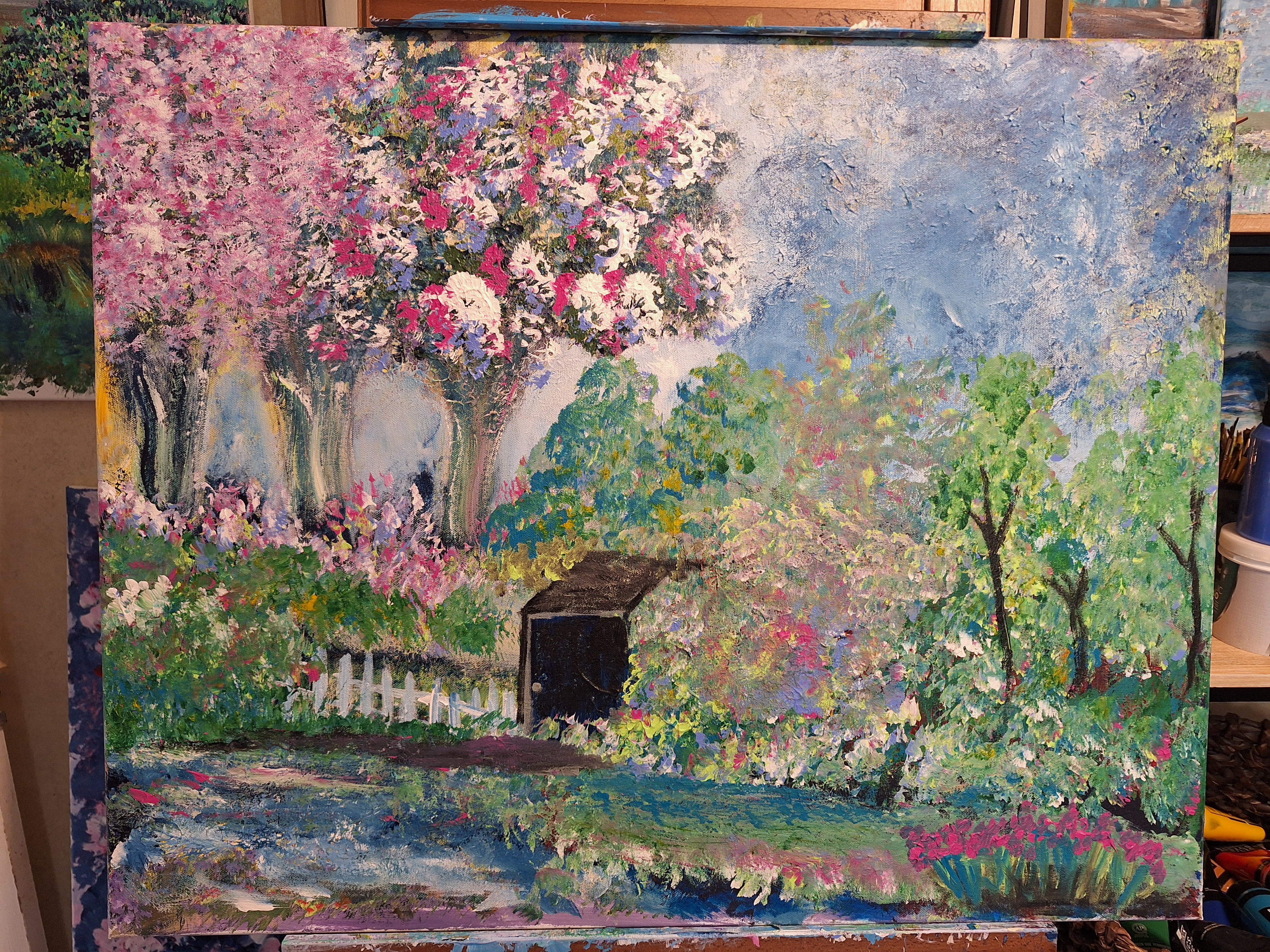
My first painting in our new home emulated the color palette outdoors (though I took liberties by adding young trees and flower beds that I intended to plant.)
My next painting was an intentional merging of my mid-grief black & white period and my post-grief big, bright botanical phase.
But this time, I painted it with a specific location in mind, pulling colors and inspiration from surrounding objects.
In January 2026, I took my first painting class – botanical landscapes/direct painting with the amazing artist Elody Gyykis (online/live class).
Elody inspired me to mix my own colors and embrace my inclination toward big, juicy brush strokes.
She also encouraged me to stop dwelling on my inability to draw and instead focus on finding ways to be expressively effective using just gestures of color.
Her passion for lighting in her studio also motivated me to move my easel and implements into our best lit space on the second floor.
Canvas by canvas, through these phases of metamorphosis, I find myself becoming a painter. Not a professional. Not an artist. Just someone who expresses and navigates life through the medium of paint.
As the garden goes in, our wheelbarrow is ever occupied moving blocks, wood, bags of moisture retaining soil for the deep vegetable beds, and dump-truck-dropped soil for in ground applications.
And I love it!
This ground work is like putting up the walls and roof on a house. There is still a long way to go before this becomes a thriving garden, but the obvious evidence of edible landscaping progress brings the dream and design into focus.
Sowing the first seeds (come and cut lettuce, peas, fava beans, chard, arugula, parsley, onion starts) and some perennial edibles (asparagus and rhubarb) activates anticipation and excitement for the future.
Checking the beds daily, tracking the days for sow to sprout (7 for come and cut lettuce, 9 for mini Chinese cabbage, 10 for arugula, 12 for spinach, 15 for fava beans, 16 for chard…) enhances anticipation of the harvest to come.
Of course, it’s harrowing planting this early. With 50 degree temperature swings and ear splitting wind gusts — the risk that seedlings will succumb to seasonal stress is high. Yet, some plants are so resilient simple seasonal care strategies can see them through.
Remay row covers are no match for 40 mile wind gusts and sub-freezing temperatures. But as the underlying mix of goat litter (manure, urine, and wood shavings) piled beneath 8 inches of soil in the raised beds begins to compost, it generates lots of heat. Tender plant roots reach deeper down, warming themselves by that internal fire on cold nights.
This goat litter under garden soil trick served me well at lower elevations in protected planting areas. But we haven’t had a decade to establish wind breaks here. So as seedlings emerge, I also cover them with plastic salad boxes repurposed as cloches on our coldest days and nights.
That remay row cover does retain some compost heat hovering above the beds. However, it’s real purpose is catten cover. (Cattens = kittens close to being cats).
The garden is surrounded by 4 foot tall electric poultry netting that mostly keeps cattens out… except when I have to take the fence down to move in materials.
The second these life of luxury lounge cattens sense my garden is unprotected — Cleo, Dorian, Angus, and Marmot collectively prowl the perimeter with a single-minded target of testing the moisture retention and percolation rates of my planting medium.
While there are certain soil life benefits to deposits of urea — the root disturbance, risk for bad bacteria, and overall ick factor — make catten protection a must right now.
In the days since I started writing this, with new plants arriving weekly and me spending all my free time in the garden, things are shaping up quickly. The already planted list has grown to include blackberries, blueberries, grapes, figs, patio peaches, French tarragon, hyssop, winter savory, lavender, rosemary, lovage, along with ornamental evergreens, peonies, heather, and other early flowering plants.
As more things make it into the ground, some of the standout elements in the landscape now will have more context and company.
In the meantime, our new favorite hot spot (literally) to unwind after all this work is even better than a pot of gold at the end of the rainbow.
Actually, make that even better than pot of gold at the end of a double rainbow.
At eight days past the spring equinox, many big things are beginning to crop up in the garden and I suspect there might be more garden updates coming soon!
In the meantime, please get outside, enjoy this beautiful time of transition, and have a very Happy Spring!
Our winter white landscape makes it all too easy to impose impossible garden dreams on this seemingly empty canvas. But this is not the blank slate it appears as now.
This landscape was in a 20 year relationship with prior caretakers. Under their nurturing, it became a beautiful lawn-covered park and deer refuge, overlooking stunning mountain views.
Equipped with a pool/cabana, covered porches, and a shed, much of the layout is already set in stone (and concrete).
It’s lovely just as it is. But this is someone else’s vision of beauty. And I can’t wait to apply a very different design sensibility to this underpainting.
Reformed Permaculturist
Garden design is a form of fortune telling. Because plants take so long to mature, we can’t plan for who we are today. We have to ask ourselves “who do I want to be” and “how do I want to live/engage in this space in the years to come?” Then we have to imagine our answers, knowing that choices we make today will also influence who we become later.
Currently, I consider myself reformed Permaculturist. I embrace systems theory because it would be madness not to. I ascribe to the ideals of people care, earth care, fair share. Yet I am not a purist and this is not my religion.
I also shamelessly indulge my aesthetic sensibilities that sit at the intersection of French Mediterranean, English Cottage, Italian Renaissance, and Arcadian style.
I consider whimsy and curation of color as critical as getting guilds right and obtaining a yield.
And I think it’s an entirely rational decision to sacrifice principle for peonies and practical for playful because I need more than a feast for my stomach. The garden is fuel for creativity, food for thought, and salve for the soul.
As much as I love wild nature, in a home garden, I am deeply drawn to the cultivated, romantic, ornate, and ordered. But is this who I want to be in the future? Will I still want to spend half my Saturday mornings studying and trying capture the play of morning light on a single flower to better see the peppering of pollen, the crenulations on the petals, and the tiny nectar drunken insects blissfully asleep after breakfast?
Yes, I think I will.
But I also want to delve more deeply into the intellectual, categorical, and historical study that goes along with it. I want to be part of the the passionate and relentless pursuit that led plantspeople to seek and evolve plants so beautiful we can’t take our eyes off them, so fragrant we want to bath in them, and so divinely delicious we’ll wait years for a first harvest. And I want to pursue design and planting perfection even though I know they are mythical destinations.
And that’s why our snow white landscape has led me to deeper thinking on John Locke’s and the idea of Tabula Rasa. Seeing this landscape as a sheet of white paper, upon which I can design my future garden and future self, makes it much easier to imagine how this garden will help me fill in the white pages in my brain, that are ready and waiting for me to fill them fresh content from my life.
John Locke’s ideas also deeply influenced some of the best early American gardeners including George Washington, John Adams, Thomas Jefferson, and James Madison (three of whom gardened in Virginia too). They all spent significant mental and physical energy devoted to imagining their landscape canvases and shaping them in ways that would influence the their human development, the experiences had by family and guests, and the course of garden history.
Of course, John Locke’s most famous contribution was his philosophical influence on the framework and language that underpins our American democracy. But Locke (like so many great philosophers) was also deeply passionate about plants. He had an extensive seed collection and exchange network. He hobnobbed with renowned botanists and kept a herbarium which he meticulously catalogued and preserved. And he actively cultivated these interests to grow in others.
With more of my life behind me than ahead of me, I want to keep John Locke’s idea that “the highest perfection of intellectual nature lies in a careful and constant pursuit of true and solid happiness” ( Essay Concerning Human Understanding) as my target. Challenging work that forces me to learn/adapt/keep up with technology, gardening, reading, writing, cooking, decorating, languages, world exploration, and cultivating appreciation will continue to be my key pathways toward that ideal.
Similar to the way Monet planned and planted his garden to inspire his paintings, I want to create a garden that inspires philosophical inquiry, the study of history, and technologically forward thinking. (Of course, it will offer opportunity to paint, provide inviting places for conversation on important (and sometimes frivolous) topics, and do a fair bit of meal enhancing.) And I specifically want to use this garden to shape myself into the person I want to become.
Nature and nurture hold hands. We can’t become our best selves in environments which don’t support human mental and physical health. But we also can’t have those environments if we don’t cultivate the intelligence to create, maintain, and enjoy them. The intersection of these influences and how they scaffold each other is the line of inquiry I am centering this new garden adventure around.
Beyond the Backyard
On the broader world stage, it also feels more important than ever to keep John Locke’s contributions top of mind. When we remember that our civil contract and American ideal is that government exists for the preservation of life, & liberty, & the pursuit of happiness (our inherent human rights) — and that we all have potential to become unchained from our conditions of birth as long as civil society supports free access to opportunities to educate ourselves — it becomes easier to hold our ground and grow ourselves in ways that will overcome any temporary tyranny trying to trump these ideals.
We have never been perfect in our implementation of these ideals. Abuses of power and breaking faith with the the population is a repetitive theme throughout history. Yet, if we holdfast to noble targets, and re-set our sights upon them regularly, we still move in the direction of something true and worthy.
Tabula Rasa
Observation, sensation, and reflection are the primary architects of our thoughts, beliefs, and ultimately our destinies. What we study now, what we contemplate, what we do with our days — that input influences what kind of artists we become while creating our human realities.
It may be harsh winter now, but spring is around the corner. And I am readying myself to become a new kind of gardener. Even when activity is hampered, preparation doesn’t have to wait.
The first delivery of garden materials arrived just before the storm. And today, the snow has cleared, the soil is warm enough, and I am ready to start laying the groundwork for the new design.
Below are some before photos of the areas I will be focusing on first.
I am using ChatGpt to help catalogue my plants, plan timing, fine tune organization. It’s also pretty good at converting photos to line drawings to help you see the bones of your landscape (or try on colors for your new chicken coop.)
There will be much more to capture and catalogue here on Simplestead as the garden takes shape. But now, now it is time to act by establishing beds, readying planting areas, and getting the framework ahead of the arrival of live plants and baby chicks!
It doesn’t matter if you have a busy, successful life in the city or the a quiet, communal life in the country, The Colony by Annika Norlin demonstrates how wrong both ways of living when they limit your horizons.
There is nothing romantic about The Colony. It doesn’t have any great answers. And it doesn’t offer any kind of ethos to ascribe to. It’s an engaging fictional perspective on human tendencies to curl up like a pill bug and let external forces push us around when life gets challenging. (Well, with the exception of one character who may or may not be a serial killer.)
Because the story doesn’t offer cohesive philosophy, many of the reviews treat it as semi-formed. But I think the book is honest and doesn’t overreach. It even tells you in the teaser that this is about questioning and disturbance — not a self-help road map for communal living.
Here’s the the book teaser:
Burnt-out from a demanding job and a bustling life in the city, Emelie has left town to spend a few days in the country. Once there, in the peaceful, verdant hills, down by the river she encounters a mysterious group of seven people, each with personal stories full of pain, alienation, and the longing to live differently. They are misfits, each in their own way, and all led by the enigmatic and charismatic Sara.
How did they end up there? Are they content with the rigid roles they’ve been assigned? And what happens when an outsider appears and is initially drawn to their alternative lifestyle but cannot help but stir things up?
The Colony does a great job of giving you just enough plot twists to make you want to follow the loose thread until the very end. At the final page, you may wonder if you — like the characters — spent too much time as a passive participant. But entrapping the reader in the various internal dialogues about victimhood, disenchantment, shame, and devolution that drive the plot is kind of what makes this such a clever bit of writing. And there is also just enough hope –for the most compelling characters who delicately embrace their wide open futures — that it delivers a satisfying ending.
I could not identify with any of the characters, even though I am also skilled at living more self-sufficient, rural, nature-based living. Yet, the forces that made that ragtag tribe stay together too long still seemed disturbingly relatable.
The concept of sunk costs — of having already paid too large a price to change direction – pervades. Everyone is so stuck in their own version of mental quicksand, they can’t see the giant, safety rope next to them. But haven’t we all been there? So, feeling sympathetic toward most of the characters came easy.
The prevailing theme that holding on too tight and too long to modes of living that no longer serve us well is a tale as old as time and isn’t unique to a specific place or type of person. And The Colony demonstrates clearly why living in rural isolation, with too few friends and limited outside experiences, when you know with certainty it has not led to personal growth or profound insights is unhealthy. But it also demonstrates why participating in our greater civil society, without cultural criticism and connection to nature, will equally lead to becoming a burnt out, desperately miserable person.
I would also note that there seems to be some literary homage to magical realism in bringing together this set of people in static isolation, forcing them to live together long-term with only occasional/mystical intervention from the outside world, and with no clear sense of time. I failed to recognize it until about half way through, so the premise sometimes seemed ridiculous and the storyline occasionally fell apart. But once I recognized this as a little Macondo, I got swept up in the compelling portrayal of how making people feel just slightly less excluded as members of narrow culture, can keep them in thrall past the point of rational decision-making.
As a reader, you are also kept in thrall, because the story unfolds in a kind of prismatic narrative spiraling that brings to light outsider/insider perspectives on the communal living members, and on Emelie (the undeclared acolyte). This device both narrows and broadens the subject matter in ways that bring the reader into direct contact with the most tedious and alluring aspects of the back to the land lifestyle, without becoming dull.
Incidentally, Sara and Emelie occupy more page time and hold undue influence over outcomes, but they don’t seem like real people. They are totems of two equally desperate identity types – the social follower who fancies themselves a social climber and the spiritual phony who thinks they are a guru. They are neon signs flashing the message: beware thebald-faced bear (unless you want to be eaten alive and mauled to death by your fragile ego).
Overall, the writing and plot, come across as authentic, accessible, thoughtful, and unique. And in contemplating it for those post, I realized I really needed this book, because my own ego has been a bit too fragile lately, with defensiveness being my bald faced bear. And I will do my best to turn away from that tendency going forward.
My on/off relationship with maintaining a blog is back on. But this time it’s personal.
No more cross-selling or clickbait. No more size specific headings, bullets, numbering, and short paragraphs tailored to the two minute attention span. No more stock photos. This time, the ads are off and consumer-driven content is quelched.
Frankly, I just don’t enjoy reading most of what gets written for a target audience. I also don’t like writing for a target audience because that process installs a kind of automatic editor in your brain – one that makes it really difficult to hear your own authentic writer’s voice.
Original, authentic narrative perspective matters profoundly. Without it, meaning gets lost and so does any chance at achieving anything approaching art.
After years of writing that way, and as I reflect on my body of published writing, I realize I only shared the polite parts of my creativity.
That distortive practice of formulaic writing had a dehumanizing, dysmorphic effect on me as a writer. And sometimes I can barely see myself in the things I write.
For a long time, I fooled myself into believing that I was still uniquely expressing some part of me even through that very narrowed target audience lens.
But my true writers voice was always out of reach.
Will I ever understand? Or will I always be searching for some illusive answer to a question I can’t quite formulate?
With my 50th birthday upon me, my reflections keep circling the skimmed stone ripples of this question current.
When I was younger, I thought age would bring wisdom. I thought experience would bring knowing. But the older I get, the less sure I become of anything. Except this.
France speaks my language.
Our relationship has been fluent for most of my adult life (even though my French language skills have remained horrendous).
The parts of France, and its culture, that I gravitate toward speak telepathically to my heart and mind. No translation required. And its wordless whispers have always offered answers to questions I didn’t even know to ask — about my culture, values, dreams, and future self.
In recent years, though, France’s hold on me had slackened. Without it, I was slipping into an insipid American oblivion. An aching sense of missing France had settled in. Like imperfectly mended bones warning of bad weather, my hollowed psychic spaces nagged me with an increasingly urgent need to go there and bask in its Je ne sais quoi.
And so, as an early half century birthday gift to myself, I rented an ancient Mas in Provence.
For eight glorious days, a group of us inhabited a rustic, majestic 400+ year old farmhouse in the Luberon region.
Bon Puis’s driveway (“the good next”), flanked by vines and stately cypress, extended its open arms enfolding us into the more intimate embrace of the terrace and house.
The massive presence of the dwelling, with scalable stone walls and cavernous window wells, overlooked a perfectly picturesque Provencal landscape. Its scenery — simultaneously cultivated and wild – blended the elegant and elaborate with the simple, comfortable, and earthy.
Delightful details — like a trough, a fountain, and other artifacts of both the modern and the antiquated around the terrace — inspired conversation as we lingered over our obligatory afternoon aperitifs.
Our days in France passed quickly in a haze of open air markets and wandering walks through the cobbled streets of ancient villages.
I felt deliriously in awe of their engineering — and swallowed whole by the immersive experience of being in places I mimicked in my impressionist paintings.
It made me acutely aware that I was the simulacrum in these enduring environs — a selfie displayed for a few moments until displaced by new content. And I reveled in that liberating notion of non-mattering.
Nights passed indulgently in le plaisir de la table and ended in a different kind of haze – one of wood smoke, wine, and fiery conversation. And all of this added up to my perfect French vacation.
Yet, it was in the hallowed hours of early morning, when delicate daylight embers began to warm away the cold blanket of night, that France conversed with me most directly.
As I woke and tiptoed down the semi-spiraled staircase, to a rickety table nestled in the one spot in the house that welcomed morning sun, the molded handrail and hand-sculpted tiles triggered my transmutation.
As I sank softly into an antique farm chair, and watched the gentle awakening of the nearby village through windowed doors, my inner American inner monologue slinked away in silence.
With my limited French vocabulary, I wrote down the events of the day before. Poor spelling, rough translations, repetitive adjectives — my words were as imperfect as the wobbly chair and table I crafted them from. Yet like these seemingly simple furnishings — made from trees that lived much longer than my current five decades, assembled with primitive carpentry skills that required a lifetime of dedication to master, imbued with an aura of authenticity through generations of use – my plain passages embodied so much more than broken French sentences.
In that silent communion — my mind an open bowl and the French countryside a perfect pestle — we pounded raw and simple thoughts into a creamy pistou: a savory spread for my hungry soul.
Réveil
In the weeks since our return home, that language mash of flavors, aromas, and experiences have transformed further into the golden distillates of afternoon pastis. And like Pastis, whenever I try to formulate American words to encapsulate my French experience, the rich liquor becomes watered down and cloudy. However, this much I can say with clarity.
Despite the remarkable amount of charm, beauty, and abundance of fairytale qualities — our trip struck a chord more real than romantic.
Like a lingering finger on the keys of a well-tuned piano or the emanations of a meditation bell — something substantial still reverberates within me.
Today marks two months since we closed on our new home. It’s only half furnished and the garden won’t go in until after the first few frosts. Yet, I already feel completely at home here.
Our thrilling birds eye vantage is energizing and mentally expansive. It reminds me to take the long view (when it soooo tempting to be short-sighted and rush to get things done).
Up here, my thoughts wander to the eons it took to form this incredible landscape and the (almost) five decades of living it took me to meander my way here.
And now, every day, I am blown away by this breathtaking work of visual wonder.
As the sun rises over the distant peaks, flooding the valley first with fog, then with golden light, my human worldly worries burn away and I become part of this miraculous skyline.
As the only human witness to this bucolic frolic, my thoughts saunter out to pasture, feasting on ideas of intrinsic value and inherent worth.
I am like a the cows all around — hungrily grazing upon this scene until my soul fills with the satisfying sense of purpose that I am here to witness this eternally evolving work of art.
My life is but blade of grass to this monumental mountain range (even though we bought the land and mortgaged the view). Yet, I am nature-made and invested with intrinsic and natural right and responsibility to engage with this play of light, air, space, and matter.
Inhabiting this landscape imbues me with all encompassing awe and gratitude.
Animal appreciation
Our animals, too, have come to appreciate our new setting.
They have been taking full advantage of the serenity and spaciousness inside and outside of our home.
The cats have a developed a profound fondness for the wide windowsills and our more plentiful plush, pillowed surfaces.
For all there is to celebrate, in our new space, there is also some learning to love to do.
Delighting in Dormers
Our gabled dormers, for example (so popular in country homes) are things I never wanted. They obstruct waterflow and create more risk for water damage in major weather events. They can also be big energy losers if poorly installed.
Until we found this place, I was specifically looking for dormerless dwelling. But after discovering this skyline stunner –so otherwise exceptionally well-suited to our needs and wants — I cast aside my distaste of dormers.
I have managed to make dormers part of the dream by embracing their inner beauty.
Inside, these overhanging alcoves feel like balconies (not roof blemishes). The largest dormer has become home to my easel paint supplies. The smaller one will soon be a book nook. And I can see myself enjoying the views from the comfort of their cozy confines come winter.
It is too soon to tell if these dormers will be drains on our roof security/electricity budget. But for better or worse, I am delighting in our dormers.
La Piscine
With our slow fall/extended summer conditions, my current favorite amenity is the backyard pool (which is now pristinely inviting thanks to Matt’s mastery of pool chemistry).
Whether swimming, reading, or reflecting, much of my (limited) free time is spent à côté de la piscine.
Frankly, I’ve longed for a pool of my own for decades. My fantasy version looked just like this, only it sat in the South of France overlooking vineyards, olive groves, and lavender fields. But I am even happier to have it here, in the gorgeous Appalachian highlands.
Speaking of French fantasies, come true, I’ve been living out another one since our move…
Brocante
This French word means second-hand. But it embodies the concept of questing for the perfect patinaed pieces to imbue a new home with historied character.
Generally, I abhor shopping. But brocante isn’t shopping! It’s a treasure hunt targeted at giving new life to old things through passionate possession. It’s romantic revitalization through fresh appreciation. And it’s far more fun and affordable than buying all new.
My first quest led me to find two perfect bedside tables – lovely pieces that had whole other lives, in separate homes, serving entirely different functions — before they blended seamlessly into my evolving guest bedroom landscape.
My most satisfying quest began with the hopeful anticipation of finding of an appropriately scaled, one-of-a-kind, conversation-starting coffee table to fill the cavernous void in front of a new semi-circular sofa. And the piece I found delivers with handmade, rustic, practical, artful elegance.
The surprise piece, the one I wasn’t looking for but had to have — an antique rolling filing cabinet, turned humidor holder — added so much interest and life to an awkward bit of blank wall.
One thing I didn’t have to buy was more garden furniture. All my old treasures are equally at home here in our new setting.
There is much to enjoy about moving into a new home and making it feel more personal. But the more meaningful work of making this space more energy sustainable and self-sufficient is still to come.
Hindsight changes everything. Our capacity to reflect back on and rearrange our past, to put things that already happened in new perspective, is one of our most powerful and creative human tools.
We can rewrite our experiences with with more depth, color, and complexity (as many times as we want). In fact, doing so is a critical part of savoring and getting more value out of the ordinary and extraordinary moments of our lives.
I’ve been doing a lot of this recently as I try to make sense of the events of 2025 that led me to where I sit today… in a new home with a new set of challenges and adventures ahead.
For most of 2025 I felt stuck and unable to make decisions. I had this sense that starting anything new would be a complete waste of time.
Now, looking back, with the creative benefit of hindsight, what felt like stagnation reads more like meaningful distraction, pause, and preparation for the unseen undercurrents shifting the ground beneath me.
Sante Fe
In spring, Matt booked us a trip to Sante Fe for a few days of art-filled exploration and to quench his thirst for the desert. Frankly, I was a reluctant travel companion because I thought I’d had a lifetime fill of desert between growing up in Southern California and year in Egypt. Turned out, I was wrong.
Walking around, gazing out across the Sangre de Cristo Mountains, that landscape infused inspiration, like creative blood, into my soul. The brittle, yet still lush, vegetative carpet running to the stark, sparse ridgeline and radiantly blue sky makes for an inviting backdrop for any artistic medium.
Being there, in that expanse of open dessert and majestic skylines, reminded me that some of the most creatively fertile periods in life came just after my dry spells.
From canvases to al fresco surfaces, along scaled serpentine sculpture walls, in a bowling alley turned immersive art experience, and across the contours of an alien space craft precariously perched outside a cute cafe — the enchanting evidence of imagination at play abounds all over Sante Fe.
In gardens, where water is scarce, playful whirligigs and carefully curated contouring terrace and swale designs catch the sun, water, and spirit of this magical place. They lure you in with grand entrances and artistic interludes and encourage you to stay with comfy seating and interesting art installations that fuel conversation and contemplation.
As Georgia O’Keeffe said:
“Nothing is less real than realism. Details are confusing. It is only by selection, by elimination, by emphasis, that we get at the real meaning of things.”
And Sante Fe is a place where the landscape and the artistic efforts of others act as conduit for this kind of emphatic selectivity in pursuit of meaning.
As Matt and I strolled the streets, museums, botanical gardens, parks, preserves, and hot springs, discovering the literary, culinary, and craft cocktail culture, my creativity reservoir ballooned, making me feel lighter and less burdened than I had for a long time.
Life felt enchanting again. As if to affirm the idea, the day after I penned that word “enchanting” in my journal, Matt and I spent an evening in an independent bookstore in Sante Fe participating in a group conversation with Brooke Williams, author of Encountering Dragonfly: Notes on the Practice of Re-enchantment.
After seeing so many paintings and art installations I expected to return home and unpack and process our trip through color and canvas. Instead, the trip (which ended on a high note with a sunrise balloon ride) led me back to the earth.
The Garden
After our trip, I went straight into the garden, to dig into the earth, and begin meaningfully distracting myself there.
Manipulating and rearranging that space with renewed creativity, reminded me we are all rooted, just as plants are to our present conditions and resources.
Being rooted, though, doesn’t make us stuck. It can make us more connected, tapped in, and able to receive the unseen energy of life more readily.
Earlier this year, I felt rooted in uncertainty. There were too many things up in the air, too much still to be determined to choose a path forward. And so I focused on using resources we already had to alter my immediate surroundings to gain fresh perspective.
Moving pavers, pots, and portable seating from one part of the garden to another added interest and gave me a new place to ruminate, with Woody and my goats as close by companions.
The “Archoretum”
I also began sculpting, shaping, and encouraging a new creative vision using a mix of living and human-made materials.
These arches, arbors, espaliered trunks, branches, and thickened vines became gateways leading to a collection of short sensory stories, written on the landscape. A new scent, a spot to sit, or a tasty tale told around every curve and corner. My own secret garden revealing itself to me anew each day.
Outside the Archoretum, my years of planting for flowering and fascinating foliage finally paid off in an incredible unfolding both fresh and patinaed blooms and lushy leaf displays. I focused on experiencing the landscape as if it were a painting being layered in by an invisible hand. I spent countless hours admiring the details, the careful placement, and subtle edits and rearrangements that happened from day to day.
The pond area required some taming of the underbrush. A few hours of careful briar removal transformed it back into a pleasant place for reflection. I relocated a table near the edge and spent many quiet mornings admiring the arched sourwood, turned semicircle when mirrored on the pond below. It made me think of Hades and Persephone and thoughts of the unseen underworld and all that we can’t know.
Kittens
We also welcomed four new kittens to our farm. It wasn’t planned. But they needed us and we needed them. They have been a daily source of joy and inspiration (and occasional exasperation as they started doing flying jujitsu and indoor gardening).
City Visit
I also got to make a trip to DC for work. I had tons of fun with my colleagues. And of course, I enjoyed the culinary scene…
Amid all these lovely experiences and creative adventures, there was an under currant of uncertainty and worry and the sensation that things were about to dramatically change.
My step dad had started calling me to ask me to look up things on the internet for my mom. For example, could I find a solitaire game with large buttons so she could play when she was alone?
This was new for us because we are both uncomfortable talking on the phone. It quickly became apparent that the requests were a ruse. He really wanted to talk about his declining health, his worry that he couldn’t care for my mom, and he wanted assurances that I would take care of her when he couldn’t. I told him the same thing every time — I would take care of him and my mom whenever he was ready to let me. And he always asked me not to tell my mom he called.
In March, after he had a bad fall that led to a medivac ride, he finally agreed it was time for him and my mom to move closer to us. I began looking for a house for them and couldn’t find anything that met his criteria. Then, he was hospitalized again.
The plan changed from a house for my parents near us, to a house that would allow my parents to live with us, while still giving them independence.
A week after we went under contract for a house that met Steve’s exact requirements (for heaven on earth), my mom called. Steve was in kidney failure and it was time for hospice. I raced to Missouri and 4 days later he was gone.
Steve never got to see the house I picked for us in the flesh. Yet sometimes, I step out on the patio and look across to the back door of the garage — the garage he told me was a must-have so he could tinker and escape his anxiety and memories of trauma. I almost see him standing there in the door frame, looking across the mountains wearing his rare and radiant smirk — the one we only got to see once in a while, in those all too precious, playful moments when he forgot his pain.
A lifelong prolific writer suddenly can’t string together a sentence. Each time she tries, her chest becomes heavy with the weight of the ideas she wants to capture and convey, but can’t. Then the fire starts in her lungs, scorching her from the inside as she searches and searches for words that become harder to find in the metaphorical smoke from the asthma burning up her insides.
At night, in bed, unable to sleep, the words and sentences bubble up, straining against an unpopped cork about to shatter the bottle neck now under extreme pressure. But the heavy heart and lung fire come too.
As she gets up to capture the words, the pain intensifies, impairing her capacity to remember what she wanted to write. As soon as she stops desperately searching for those uncommitted sentences, the physical pain subsides.
Healing with Art
Wordless and alone with a blank mind and a blank canvas, she reaches for brushes and the cheap acrylic craft paints she has on hand. She creates shapes and tries to color over her lost identity because she doesn’t know who she is if she can’t write.
There is a gaping schism in her life and she feels the widening distance between the writer she used to be and the no one she is becoming.
Here, she expresses in paint that which she can no longer record in her journal. Even penning her personal reflection on those private pages, her long time mechanism for finding herself and her way in the world, has been lost to her. She is nothing without her capacity to craft words and the emptiness of night is the only time she doesn’t feel like a fraud.
Here alone, she can be nothing. She can feel at ease with her loss of identity. She doesn’t have to maintain some artificial, imaginary thread between who she used to be in the world and the wordless soul adrift she has become.
Here in the night, she entertains herself with pretty colors on paper because she has has allowed herself to be reborn as woman-child, learning a new medium, to survive without sentences.
Here she creates secret paths and doorways on canvases that lead to places words can’t go. She reflects on trips taken, experiences had, and tries to remake herself in a new image.
Lately, words have returned, less free-flowing than before. Yet, more meaningful sentences take shape and important ideas become less illusive in the intense struggle to write.
Writer with a Word Problem
Mine was not a true aphasia. It was an emotional aphasia — mystically transferred to me in the days leading up to the death of the true aphasia bearer.
My dad, Mike Greer, suffered a massive, nearly terminal brain bleed that wiped out his capacity to create new memories for the last 8 years of his life.
Like an abstract painter, he could capture only elusive strokes of what came before. Yet the images were sometimes more meaningful and beautiful in their incompleteness. Along with that memory loss, came inability to use and comprehend language – spoken, heard, written, read.
In a final departing gift, his global aphasia seemingly splintered and pierced my heart, paralyzing my power to pen sentences without pain. After his death — as I struggled to learn wordless ways of expression through the medium of pain and paint — it became obvious to me that my dad had a similar experience after his stroke.
He had not learned to communicate in paint when his words failed because even pictorial representations read like a foreign language to him. He did it with love, impeccable comedic timing, and overtly obvious graciousness that made his attention givers feel deeply appreciated.
The Subconscious
After his passing, many people, trying to offer solace, told me my dad had gone on to a better place. That idea – so completely incongruous with who my dad was in life and what he believed — made me physically repulsed and eager to flee. Yet, instead, I channeled his post-stroke, overtly gracious persona and tried to receive the intent behind the words, even as the actual words abraded my inner ear skin like sandpaper. I am grateful for the example of his wordless years because it saved me from alienating good people I care about over words that were meant with love.
My dad did not believe in heaven and hell, except the ones we make for ourselves while incarnated in human form. He thought most humans were exceptionally good at taking the short, bright, easy paths that lead only to a constant need to dull their disappointment and boredom with the hope of some great hereafter, drugs, distraction, or all three.
He held no malice for people who chose to live what he called those kind of surface lives. But he taught me to believe only in things you couldn’t see from the trailhead. He urged me to search for signs from my subconscious and clues in my dreams, to listen to my deeper self, and whenever possible to choose the riskier, less obvious, and possibly failure-strewn paths precisely because they made better fodder for writing stories worth telling and led to more moments of profound meaning to reflect back on.
My dad also believed we would all spend time in a transition space before our next incarnation — a kind of reflective purgatory where we would reconcile with our past to prepare for our next return. He believed his purgatory (this time) would be lengthy because he had to reckon with the sins of his psychosis that started with a schizophrenic break at age 18.
While institutionalized, he was diagnosed with multiple personality disorder and delusions of grandeur. Once released, he began a life long battle between his brain-driven urges and his heart’s desire to be civilized. He spent most of his time on earth in philosophical pursuit to avoid succumbing to the side of his Janus-self he could not tolerate.
He worked as an overnight security guard so he could read books and take walks for a living. He loved philosophical discourse so much that he once he spent 11 cassette tape hours, sharing his knowledge on Socrates with me so I could use him as a source for my term paper.
For a person with that much to say on a single subject, eight years without memory or language seemed like a diabolically perfect purgatory. And as his caretaker/witness bearer during those post-stroke years, it also became a perfect purgatory for me to work out my sins as well. (Mine stem not from psychosis, but from lack of self-esteem and a deeply held belief that I must continually prove myself worthy of love to receive it.)
As our shared purgatory drew to an end, for three days leading up to his death on April 25, 2024, my dad’s language skills were miraculously resurrected. Like Lazarus, his language came back from the dead, smothered and suffocated dark side of his brain and he became able to string together complete sentences for the first time since March 2016.
Some of the last words he spoke to me were “I’m going to die soon. It’s not good. It’s not bad. It’s normal. It’s fine. It will be okay.”
To which I responded, “I know.”
That memory becomes infused with different kinds of meaning and new nuanced details upon each new examination. Yet the constant, in each reframed iteration, is the acute pain in my heart and inability to say more than “I know” as the certainty of his impending death settled over me.
Perhaps that was the very moment when a sliver of his aphasia pierced my heart and stayed my pen. Perhaps on a subconscious level, I knowingly exchanged my writing skills to hear him speak those final words of comfort. Certainly, some deep part of me would sacrificed anything to know what he thought as he peered over the ledge on the precipice of death.
Or perhaps, this is just my way of turning a moment of meaning met into fodder for a story worth telling.
As the 1st anniversary of my dad’s after this life approaches, and of my life after dad’s death, those countless sleepless nights and color-filled canvasses have begun to heal the schism inside me. And his old bedroom has become my art studio turned dining room.
After his stroke, I divided my dad into two different people because I couldn’t reconcile the old child he’d become and with the wise father who taught me to live a philosophically seeking life. I put the wise father version of him on hold, as if he was still there just out of the picture somehow. I suppressed memories of him because when I thought of him, it made me angry at the child in his body and sad over all the conversations I could no longer have with him.
By seperating the “wise father” part of him, it allowed me to embrace the “child dad” as a different person and care for him as a mother would, with unconditional love. In retrospect, that choice may have been the shallow path my dad warned me to avoid. Yet I do not know how I could have survived those eight years in purgatory with my dad any other way.
For his whole adult life, my dad carried within him bifurcated versions of his personality. Like the story of the two wolves inside us all, he worked hard to feed the one he considered his better self.
As his daughter, I knew the nature of his two selves. I was able to love him wholly knowing all that he was and all that he tried not to be. And so it smacks of strange irony that I had to mentally separate my before-stroke-dad from my post-stroke-dad to be daughter to one and caretaker to the other.
Over this year since his passing, sharing his aphasia (however it came it be), I have begun to reconcile that inconsistency within myself. I can now see the continuous thread of his humanity in the two warring versions of himself and the pre and post stroke versions I created as an act of self-preservation.
In the prism person he was, and I made him out to be, there was also something constant and uniquely him. And I like to believe that that continuity, went on to something new here on earth after he left his body.
It’s not good. It’s not bad. It’s normal. It’s fine. It will be okay.
I like to believe that as my dad peered over the precipice, and spoke those last words of wisdom, he became one whole and made his peace with his internal struggle.
I like to believe that I will too. I am searching for signs from my subconscious and my dreams, listening to my deeper self, and looking for the riskier path that will make for better fodder for my story and allow more moments of meaning to reflect back on. And I am trying to love the part of me that has nothing to prove to earn it.
You only have one life, until the next, as my dad used to say.
Strolling down Chartes street, in New Orleans, I spotted a painted sign with a tea cup and saucer hanging above a shop door. Like a moth to a flame, I flitted in that direction.
As I approached it, I read the name “Bottom of the Cup”. Then, in smaller lettering just below the saucer, it said this.
Psychic Readings
The moment I comprehended those words, I predicted I would have my tea leaves read during our vacation. I do Tarot and palm readings as party tricks. So, as a consummate tea drinker, the thought of finding inspiration in spent leaves instantly engaged my imagination. I knew I had to learn more.
Spoiler alert! I am not psychic. I can’t predict the future for myself or anyone else. I also don’t believe that anyone else can predict my future. However, I do believe that the world is a place of patterns that like to repeat themselves (which is why even hideous things come back in style).
Focusing on the archetypal images in a spread of colorful cards (and a person’s reactions to them) or studying a person’s palm lines can offer insight into the patterns at work in their lives. And sometimes having an outsider call attention to those patterns is just what the querant needs to find their own way forward.
Tarot
Tarot is particularly useful for discerning a person’s present patterns. For example, as I flip over the hanged man, people who have a habit of being overly self-critical, or those who are actively doing something they believe is wrong, will show immediate signs of discomfort.
Their reaction prompts me to say something like “this card tells me there’s something you feel guilty about right now.” If they’ve done something genuinely wrong, they will overreact and confirm their sense of guilt. If they’ve just been beating themselves up over a minor mistakes, they will look confused.
For the former response, I’ll say the “This card is a warning that you should think carefully about the choices you are making before you continue down the path you are on. Ask yourself – is whatever you feel guilty about worth the risk or possible pain it might cause others?”
For the latter, I’ll clarify. “It’s probably mild guilt, like perhaps you made a mistake or feel like you could have done better at something. This card is a sign that you have punished yourself enough.”
People with a tendency to judge and blame others harshly will often react with an air smugness when faced with the hanged man. They interpret the card as a sign that someone who has wronged them will be justly punished.
In that case, I might say “This card suggests you feel like someone in your life has wronged you. This card is a sign that you might gain insight into resolving the situation if you consider how your actions could have contributed to the problem.”
Frankly, this is such broad advice that even if I miss the mark entirely, the querant usually finds some situation to apply the reading to. And the meaning they attach to the reading is actually what matters most.
Ultimately it’s our personal interpretations, of the very generic insights revealed in the cards, that provide perspective to deal with whatever made us desire a reading in the first place.
Palm Reading
Palm reading offers a deeper look into a person’s past than Tarot. For example, you can always identify the adventurous and active people because their hands are more deeply and densely lined than sedentary querants.
So, to the person with plenty of deep lines on their hands, I might say, “You have lived a life rich in powerful experiences that have left their mark on you. You probably have a lot of hobbies and enjoy new adventures.” That usually prompts some kind of confirmation or leads to dialogue that gives me more clues about a person’s interests.
From there, I might discern that they’ve been stuck on an adventure treadmill and aren’t finding it so exciting anymore. That might prompt a suggestion that sometimes the adventure we need now is time to digest and dwell on our past experiences.
Alternatively, I might discover it’s been a while since they did anything they consider exciting or engaged in new learning. So, that might prompt me to suggest it’s time to try something new or do something frivolous and fun.
You can also tell if someone uses a pen or pencil often by the flat spot on their center finger. So, then I might guess that they are creative and probably enjoy writing or drawing. That leads to conversation about whether those mediums are currently satisfying and possible ways to reinvigorate their usefulness.
Meanwhile, people who do a lot of smartphone typing tend to have agile thumbs that move readily when I examine their hands. So, I might guess that they have vibrant online lives either at work or in their personal lives.
When you combine the condition of a person’s hands, with other revealing mannerisms (like the mobile-addicted person looks at their phone every 3 minutes), it becomes easier to guess at what general advice might resonate for the querant.
For the phone obsessed person, I might see that their head line is looking a little shallow. I might then encourage a deeper connection with nature or some other sustained offline activity that requires uninterrupted focus.
I never know what’s going to come up in a reading which is why it’s also an adventure for me to read palms and Tarot. But the goal is always to get a glimpse into present patterns to help the querant read into their own future.
It’s also impossible for me escape being biased by my personal situation when doing a reading. So quite often, I end up giving querants the kind of encouragement I’d like to hear if I were on the other side of a reading.
Still, since many of us are grappling with variations of the same concerns and themes, most querents find enough value in my “sage” advice to engage with the patterns of repetition that have them temporarily stuck in a rut.
Tasseography
Now, that I have revealed my non-psychic approach to giving “psychic” readings, you might be wondering why I’d spend $35 for a 10 minute psychic tea leaf reading.
At the outset, I told myself I wanted to learn a new form of entertainment for tea parties. However by the end of my reading, I knew I just needed to be on the other side of the table to see my present patterns from a new perspective.
Tea Leaf Reading
My tea leaf reader was a young black man who looked more like a wrestler than a mystic, until he spoke. Then his feminine sing-song voice, and utter avoidance of eye contact, made clear that he was less grounded in the physical world than his stalky mass implied.
He led me to a private closet-sized room, one of four, and sat me across a desk from him. We introduced ourselves. He told me he would be looking for signs about my next three months in the general areas of health, family, relationships, and work. Then he asked me to swirl a white diner-style coffee cup, topped with a paper towel and a coffee plate, and flip it over when I felt ready.
As I picked up the cup, I noticed there wasn’t enough liquid in the leaves to get them to swirl. Their stodgy weight sat heavily on the handle side of the cup.
I did dutifully swirl as instructed. But then I shook the cup vigorously side to side trying for more even distribution.
If I were reading for someone else, observing the fact that my querant tried to control the outcome of the reading would’ve made me find a sign in the cup I could use to encourage the querant to be open to spontaneous experiences.
When I flipped the cup over, onto the paper towel, most of the leaves remained stubbornly situated on the handle side of the cup. However, a large lump of leaves mounded at the center, looking ominously like a freshly covered grave.
I immediately interpreted it as the tea leaf version of the Death card in a Tarot deck. Then I thought of my recent forays — to Tremé for a funeral procession, peering through the gates of Lafayette Cemetery and standing in front of deceased author Anne Rice’s New Orleans house — and a painful morning message letting us know a dear friend passed overnight.
A moment later, I remembered the reader’s job is never to focus on the literal meanings of the images in a reading. A death card never warns of death and it never references a recent death. Instead, it’s a harbinger of change or the need to change. It’s a transition card.
Buried Truths
My tasseomancer didn’t see death at all. He interpreted that lump of leaves as there being something at the center of my life that was an unreconciled burden. He thought it was most likely a person I had unresolved feelings over or unresolved issues with.
As he said this, I thought of my dad and of the purgatory that has been his last 7+ years of living in a state of global aphasia with a complete inability to store new memories. Then I thought of myself and how I’d also been sharing his life sentence in some ways.
Adventure
In addition to this lump, a fine streak of tea leaves circled the rim zone of the dumped leaves. It was the only notable evidence of my absurd effort to shape the outcome of my reading.
My reader giggled as he told me that wild streak meant I had some adventures coming. And I thought, “Please let him be right!”
After grounding the reading in the dumped formations, my reader then turned his attention to the leaf residue still in the cup. “Your reading is like a starry night sky. There are so many options in here, it’s hard to decide which to focus on.”
This struck me as incredibly applicable as I’ve been searching for something new to focus on now that I feel settled back in to legal management. There seem to be so many possibilities. But none have had the gravity to hold my interest yet.
Love
On the topic of love, there was a hammer, a dog, and a dragon. Their pattern suggested to my reader that I would need to infuse my long-time relationship with more excitement and put in more work to keep it healthy.
When I shared this part of the reading with Matt he protested. Yet, like the starry sky reference, this rang true too.
Matt and I have been together 13 wonderful years. However for almost eight of them, I’ve been bound by caring for my dad. We’ve put so many adventures on hold that the undone things are stopped up like an over-carbonated Champagne bottle at risk for bursting into a broken mess.
Our recent trips to the Chapel Hill area and New Orleans have eased us back toward the path we put on hold. They’ve helped me remember how important it is to create common stories (we can look back on together) and to connect to each other in new landscapes and intellectual spheres.
Yet, these brief excursions have also made me aware of how rigid I’ve become as a caretaker of someone who requires a very limited scope of experience for safety. I have such an established pattern of controlling conditions that I’ve become the kind of person who worries about tea leaf distribution in a psychic reading.
Meeting new places in my current state of mind won’t be enough to make me the adventure partner Matt deserves. I have to use that hammer in my reading to actively tear down some of the limiting behavior patterns I’ve fallen into so I can fully embrace shared experiences.
Health
The most exciting symbol in my reading (according to my reader) was a Genie’s lamp in the center of my cup. My reader said he only saw that symbol in one other reading before. To him, it meant that I had the power to make a wish for someone in my family and it would come true.
My first thoughts were for my mom and step Dad, then my dad. If only I could wish them renewed youth and the return of their former good health. But I’m too practical to wish for the impossible.
Ultimately, I spent my wish on my brother who recently had a run in with an aggressive cancer, that was thankfully caught in time.
Work
My reader also told me to expect a promotion within the next three months. He said that whatever projects or tasks I was working on now were earning me notice and would lead to some kind of big title or status change. He didn’t explain which images in the cup led to that prediction, but he was absolutely certain.
Though intended as a positive, the reader’s words struck me like a powerful warning of possible danger ahead.
My current challenge is trying not to slip back into my old role of leading large teams and managing complex projects. Yet, I keep succumbing to the seduction of seemingly small restoration projects that turn out to be the tips of buried pyramids poking through the sand.
Surprise Meaning
Since I didn’t offer up much conversation during my reading, my tasseomancer rapidly ran out of symbolic material in the tea cup. With a few minutes left on the 10 minute clock, he asked if there was any particular reason why I wanted a reading.
Words I don’t remember forming, poured from my mouth.
“I’ve forgotten how to take meaningful risks.” I said.
My reader pushed the tea cup aside. He looked me direct in the eye for the first time and said, “Oh, that’s easy. You need to get your head back into the fairy world. You’ve shut out the magic. But you can have it back. You just need to ask for it.”
Inviting Magic
In the process of writing this post, I’ve realized just how right my reader was. I do need to get my head back in the fairy world, even if I don’t believe in actual fairies.
Sometimes, inviting magic requires us to recognize that we’ve become too well-rooted in our present pot. Welcoming magic for me means making the active decision to transplant myself into new circumstances so I can continue to grow.
Wandering the streets of New Orleans, eating our way through a roster must-try restaurants with close friends, and allowing the city to cast it’s voodoo, hoodoo spells over me, has turned out to be a great kickstart for inviting magic into my life.
I hope you enjoyed a taste of our travels in New Orleans in the photos above and got a glimpse in to how to use the not-so-psychic art of psychic readings to help spot present patterns that might be making you feel stuck.
Most of all, though, I hope that you invite magic and many new adventures into your life in 2024!
This month, work took me to the windy city. Though sleep was hard to come by while there — with the sirens sounding, cars racing around at all hours, and industrial equipment turning on and off all night long — the change of scenery was still wonderfully refreshing.
I also enjoyed the opportunity to engage with colleagues on topics related to emerging technologies like artificial intelligence and copyright concerns (as more and more of what counts as “creative” relies upon engagement with algorithms and machine learning).
And when I returned from that work trip, just three days later, my home of nearly nine years seemed like a strange, foreign, and utterly magical place.
An overwhelming sense of having stepped into an alternate reality took hold.
Stumbling into other worlds is one of my favorite literary themes. But to experience it, just by coming home to a place I’d left only a few days prior, was completely unexpected plot twist.
The residue of “otherness” — of having been transported to an alternate dimension — lingered long after I’d settled back in.
It allowed me see these old places in new ways.
Around every corner, something so striking and other worldly stood out and I began to believe that leaving and returning really did somehow change everything.
That few days of distance has changed my perspective entirely.
I am no longer seeing our landscape from the perspective of thinking of myself as it’s creator.
I am now seeing it with fresh eyes, like a traveler, exploring some exciting new destination.
Although, come to think if it… Woody (my pet turkey) does look remarkably like an alien being from another planet. So, maybe I have been transported to an alternate reality after all!
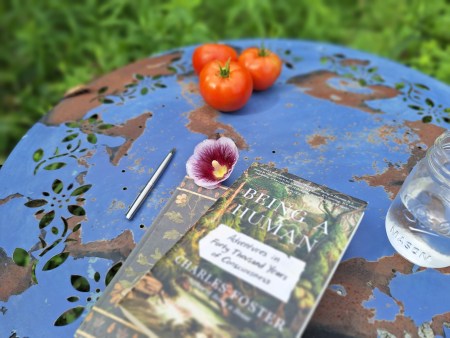
In Being Human, the author and his son attempt to travel back in time by way of a thought experiment and lifestyle immersion. Their first journey is into the Upper Paleolithic period (about 35,000 to 40,000 years ago) to the era of the hunter-gatherers.
In the introduction, Foster says:
Hunter-gatherers were — and the few that survive often are — wanderers, reverently and often ecstatically connected to lots of land and many species… For most, settlement wasn’t an option, and even if it had been, it would have been unappealing. Why chew on rusk all your life when you can graze from a vast, succulent and ever-changing buffet?
This summer, I have journeyed in a similar fashion becoming something of a hunter-gatherer.
Only in my case, all the hunting and gathering has been done in my own garden.
I’ve wandered this semi-cultivated wildness, popping fruit into my mouth fresh, unwashed, whenever the mood struck.
I’ve spent hours studying small sections of the garden, reverently and ecstatically relating to all of this not as “mine” and not as “other” but as an extension of my being.
What I haven’t done much of though is “garden” .
In previous years, I’ve needed to maintain a certain amount of “tidy” in my garden because I was using the space to take photos for books and articles and to make videos.
Now that I’ve changed direction and am only writing here, for a more intimate audience, I’ve given up that pretense.
The garden has become a wild beauty with outcroppings of cultivation ensconced amid formidable, forgeable food forests.
Less frequently mowed paths, more tolerance for milkweed, unkempt vining plants, and branches bending under the weight of unthinned fruit, lead to beds overflowing with flowers.
Some might see all this as garden neglect. But the plants seem to see it otherwise, as do all of the insects and birds that have continued to increase in population.
And the endless bounty of tomatoes, fruit, herbs, and fodder for the goats prove beyond doubt that most of what qualifies as “good gardening” is no longer necessary now that we’ve attended to the health of our soil.
Next up in Being Human is the neolithic period, or the age of domestication. I have put off reading that section (until cooler weather) because I know where it leads.
It leads to me picking up my garden tools and reclaiming my real role in our landscape as arbiter elegantiarum (arbiter of taste) — conforming the natural world to both my aesthetic and edible preferences.
So, as I lingered a little longer in the less cultivated parts of our human past and reveled in doing less cultivation in my garden, I took a side step to read Savoring: A New Model of Positive Experience by Fred B. Bryant and Joseph Veroff.
Savoring is defined as the processes by which people actively derive pleasure and fulfillment in relation to positive experience.
Savoring intersects with all sorts of positive mental health tools like meditation, mindfulness, daydreaming, and working with time and emotional intelligence. Yet it is also a uniquely nuanced tool for pleasurable living.
According to the authors, savoring entails:
…a deliberate contemplation of one’s own inner experience. Rather than turning away from positive thoughts and feelings that arise in the moment, when one savors, one intentionally reflects on these experiences, mulling them over “swishing them around” in one’s mind, so to speak, as one would savor a fine wine on one’s palate. In this process, one explicitly acknowledges associated thoughts and feelings that arise, further enhancing enjoyment.
Life is full of challenges that we often make more difficult by swishing them around in our minds. We compound the negative by replaying hardships long after the actual pain has passed. But we can do the same with our positive experiences.
Negative repetition seems hardwired into us. Savoring, by contrast, doesn’t come quite as naturally. Yet savoring is a discipline we can learn to do well.
As a caretaker of someone with mental and physical limitations, I sometimes feel cut off from many of the activities that constitute my idea of the “good life”.
My asthma, too, limits my access to places with certain kinds of pollution. But savoring, as described above, has been my saving grace, opening the world and making it grand again.
The modes of savoring such as marveling, thanksgiving, basking, and luxuriating are available to every one of us, no matter our status or our limitations. We can expand our enjoyment by learning to savor the pleasurable and then practicing frequently.
For most people, it’s not really the big, epic life events that bring us pleasure. Those times are often too hectic and overwhelming to fully appreciate. Those events bring joy later when we remember.
This summer, so many little pleasures, deeply and fully embraced, have made some extra challenges in my life of late more bearable. There is still hardship. There is still pain. But there is also room between those things to savor small moments of joy.
Just in case you are in a similar place, you don’t need to read a book to start savoring. You also don’t need your life to be anything other than what it is right now.
The next time you find yourself enjoying something — no matter how seemingly small or unimportant — stop and savor the experience.
Swish it around in your mind like a fine wine.
Allow it to permeate your senses.
Marvel at it.
Give thanks for it. Bask in it. And luxuriate in the experience as long as you can.
Then, remember the experience fondly as often as possible.
If I were to sum up my life right now in one word it would be this:
LUSH
The garden is coming into peak season with cabbages sizing up, the first peppers appearing, herbs branching, and flowers blooming.
The foliage is now so thick in some places that my garden “rooms” feel as enclosed as an actual room inside our home.
But it’s not just the cold hardy kiwi offering all the structure and interest anymore.
The espalier arches, that I started from crab apple cuttings two years ago, have begun to give shape to the “hallways” between the rooms.
The tri-colored willows, from last summer, now paint a pretty picture behind the bird cage and contemplative bench seat (that doubles as a drainage infiltration basin). And the Bonfire patio peaches, recently planted, are adding so much visual interest to my row vegetable area.
In my newish front garden, the crusher run granite and inexpensive concrete blocks have taken on an aged patina making them seem more old world and at peace with this place.
In fact, everything is so stunningly settled, that even though I planned and implemented all of these elements, I keep having the Talking Heads experience.
This is not my beautiful garden, this is not my beautiful life.
It simply seems unbelievable that our landscape today is the same one we moved into in 2014.
How is it even possible that the fence that once stood out like an eye sore, is now nearly invisible amid the verdant growth?
I also continue to find it hard to fathom how much beautiful, delicious food can come from spaces that provide so much year round pleasure — with less work than it used to take me to maintain a suburban lawn.
In truth, I know exactly how we managed this – incrementally over time — using concepts learned from Permaculture and nature. Plus we added in decorative and lifestyle supporting details to make our edible landscape an outdoor living area as well.
It wasn’t an epic weekend makeover. It’s been 9 years of passionate, pleasurable, conscientious cultivation to create this lush landscape we call home.
Of course, we also made mistakes, had to change course and redo things, and often wasted time and money due to wishful thinking and poor planning.
For example, by the time I learned how to effectively grow a diverse garden in a greenhouse it was nearly time to replace every panel. At a price tag twice as high as our original cost to purchase, we’ve decided not to buy more plastic that will just end up in the landfill some day. So…
Now we use our greenhouse as a lovely covered patio with bistro seating.
Thankfully, even in it’s present state of disrepair, the greenhouse still offers a place of peaceful retreat from inclement weather. It just can’t house frost sensitive plants any more.
Our landscape, though, isn’t the only part of my life that is lush – in the “lavishly productive” sense.
I am also approaching my 5 month anniversary of being back to work at my prior law firm after an 8 year career shift. And I am having a similar challenges reconciling the law firm landscape I used to work in with the present environment I am actively engaging in.
This new professional landscape is so much bigger and more complex than the small area of law I used to inhabit. Settling into it very much resembles the kind of scaling up of skills and experience that were necessary to establish our Epicurean homestead.
Yet there is also this conflicting sense of going back to a landscape I helped design, grow and improve. And so much of the infrastructure I put in place is still there. And still, in the intervening years, countless new things have been planted by others, taken root, and matured.
Between remote work, a larger group, more offices, a lengthier list of software applications and service departments to engage with — the professional landscape today is as startling to me in its difference as the before and after photos above. But unlike my landscape here, I was not a participant in the incremental change as it happened.
So, I have had to shift my mind set from “going back” to “starting anew”.
Truthfully though, that makes it so much more fun because I get to desk travel to an exciting new world outside our homestead every day when I log in. This adds new layers of richness, connection, and meaningful experience to the lush landscape of my life.
I recently posted photos of the deeply discounted roses, plucked from the half-dead shelf at the hardware store, that I planted last year. When my sister saw the images, she remarked “It’s like a fairytale.”
As much as I dislike the modern concept of fairytale, I know what she means. There’s something sublime about a bouquet of roses spilling over a gravel path. The eternal and ephemeral intertwine in a tale as old as time yet as fresh as spring.
Roses, after all, are both an ancient species and a timeless classic in any garden. Fossil evidence for plants in the rose family date back at least 35 million years. And human cultivation of roses for pleasure has been ongoing for at least 5000 years.
Today, over 150 species of roses are in cultivation for planting, cutting, and rose oil. Thousands of new hybrid varieties have been coaxed into existence for pleasure and profit.
Despite market saturation, in both bouquet sales and prêt-à-planter shrubbery, roses are still so “hot” that they’ve become an $11 billion industry. And even though they are incredibly common, an air of pomp and circumstance still swirls around the fragrant, silky petals of this pretty plant family.
Relating to Roses
Once upon a time, though, I used to despise roses. They seemed too elitist and troublesome for my earthy ideals.
Plus, frankly, the environmental impact related to rose production has a pretty thorny history. Between growing them in hot houses, flying them around the world for manufactured holidays, and the excessive use of pesticides — roses used to be ecologically unconscionable.
Thankfully, today, there are lovely alternatives to the old unsustainable model of rose production.
You can grow disease-resistant cultivars organically at home.
Locally grown flower businesses are booming.
And if you must have a bouquet of roses in February, you can now buy them from fair trade certified, sustainable sources and actually have a positive financial impact on developing countries.
Wild Roses
For me though, it wasn’t the awareness of new alternatives that put me on a path lined with roses. Instead, it was a small, weedy patch of mini-pink roses growing in our otherwise barren front yard.
Since the soil was in such bad shape, it seemed like a miracle that the roses bloomed. So, I took them as an optimistic omen and let them stay.
Then, as our ducks began to do their organically beneficial business in the area, those rambling roses responded by becoming a thorned thicket so massive even a fairytale prince could not cut a path through!
So, when I finally began terracing, planning, and planting what would eventually become my fancy front yard garden, I had a choice to make.
Start a war of the roses or make peace with these pretty plants already in place?
As the author of Weed-Free Gardening, I made the sensible choice. I made those easy to grow roses part of the plan rather than treating them as a problem.
I trained those previously unruly brambles over posts cut from another weedy plant — a coppiced Princess Tree (Paulownia tomentosa). Then I rescued some large flowered cultivars from the plant discount rack to complement their country cousins. And the result has been stunning!
Not a Fairytale
Full disclosure, lest you think I’ve gone too cultivated in my tastes, my rose garden is hardly the vision of a manicured French Manoir or royal garden. These rose beds back up to a wild patch.
The gravel terrace they grace the edges of is a drainage device made with local crusher run from the quarry down the road.
Also, as with all my cultivated garden areas, this is an edible landscape, surrounded by apples on one side, quinces on another, hops to the back, and grapes in between.
Vegetable beds line the paths for easy harvest. And come and cut French culinary mint is my ground cover, working to wick away moisture and secure organic matter in our wetter-than-roses-like-it climate.
This space may look like a fairytale in photos and feels like one when I’m sitting in it sipping tea surrounded by blooming roses. But it is grounded in the reality of gardening on a mountain slope, in heavy clay in Northwestern North Carolina.
These plants are also part of an organically managed ecosystem wherein these thorny thickets offer safe haven for all sorts of wildlife.
“It is the time you have wasted for your rose that makes your rose so important.” ― Antoine de Saint-Exupéry, The Little Prince
Matt’s got the most amazing vocabulary. It’s so impressive that even when he’s correcting my pronunciation or challenging my word selection, I’ve come to appreciate that it’s not because he’s an intellectual snob. It’s because he considers me a person with the capacity to benefit from his linguistic superiority.
So… last night in the garden, when he used the word befuzzlement during our conversation, I was happy to offer him a similar service.
Since I recognize Matt as person capable of benefiting from my linguistic superiority (in this instance), I told him befuzzlement wasn’t a real word, even in a slang dictionary.
Matt didn’t accept my benevolent attempt to help him hone his linguistic acumen quite as gracefully as I do when he corrects me.
In fact, he emphatically reiterated his certainty that I was wrong and he was right.
So, rather than spend an otherwise gorgeous evening in discord (or discourse over such a trivial topic), we agreed to consult the confuser in our phones.
A quick google search revealed that I was (for once) correct and Matt was (for once) wrong.
Befuzzlement is not a recognized word in any reputable dictionary – official, urban, colloquial, or otherwise.
Given the sheer number of times Matt has accurately corrected my word selection over the years, my satisfaction at being able to provide him a similar service was understandably immense.
Once proven wrong by outside counsel, with surprising grace, Matt finally admitted that he had muddled befuddled and puzzled to come up with befuzzled.
And frankly, I could hardly blame him for making that mistake.
We were sitting at the center of our edible landscape, surrounded by such incredible natural splendor, that it was hard to focus on the conversation.
In fact, it was such a stunningly beautiful and enjoyable evening in the garden that I wanted to memorialize it with photos here on my personal blog.
Also, I kind of understand Matt’s befuddlement over befuzzlement.
Moments before that verbal blunder, we’d been discussing how bumblebees are almost mammalian in appearance. They’re like tiny teddy bears that you almost want to snuggle.
We’d also talked about how fuzzy and soft the spring oregano appeared.
Plus, we had the feathery, fluffy, fuzzy, frizzy, fronds of fennel on our minds.
Actually… maybe befuzzlement should be a word.
We can define it as what happens to a person’s vocabulary when they are completely intoxicated by the influence of the spring garden.